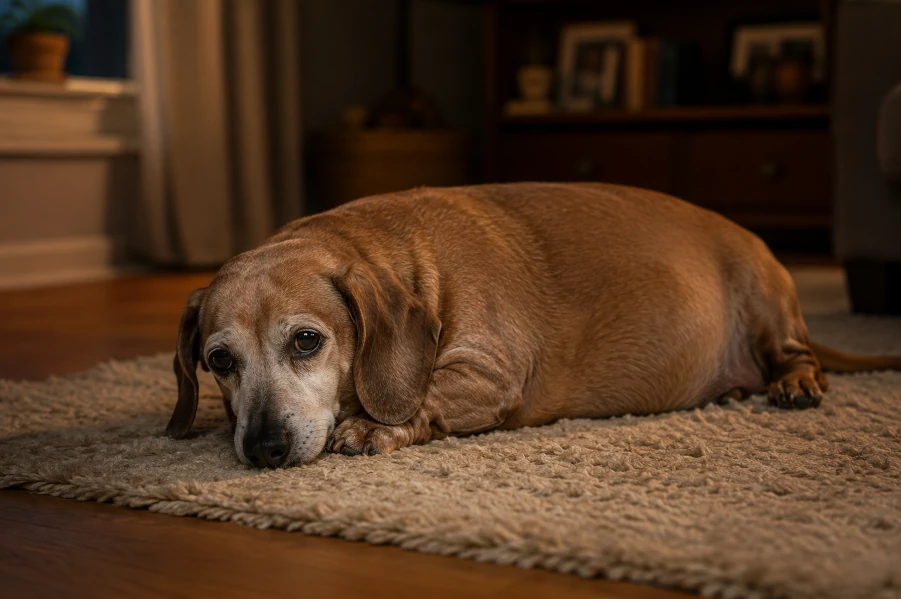
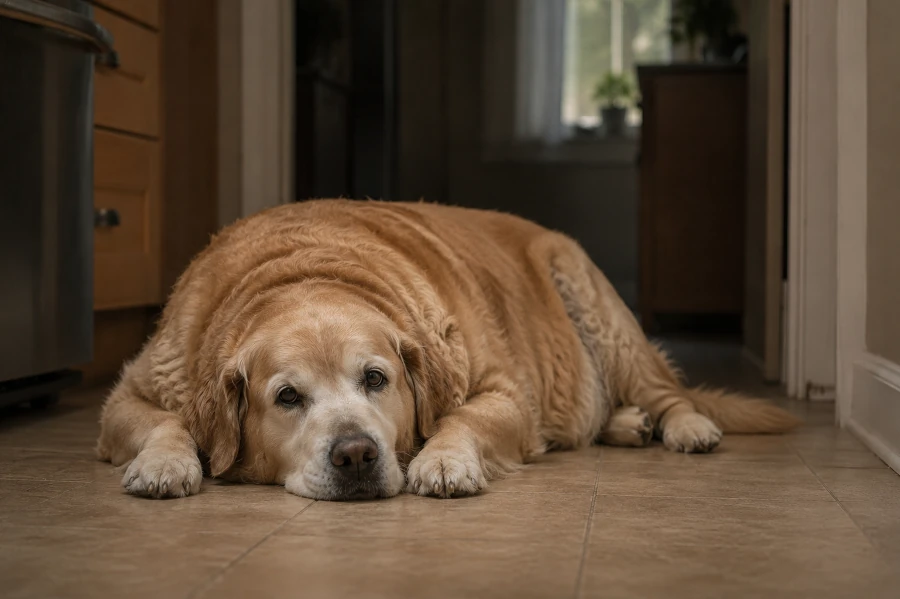
Weight gain in senior dogs often happens so quietly that you don’t notice it right away.
It doesn’t feel like a problem at first.
Maybe you even smile about it.
“He’s just getting a bit chubby.”
“He looks cute like this.”
“He’s eating well, that’s a good sign… right?”
That’s exactly how it starts.
I remember thinking the same. My dog hadn’t changed his routine. Same food, same portions, same walks. And yet, little by little, his body was changing.
His waist disappeared.
His movements slowed down.
Getting up took just a bit more effort.
Nothing dramatic. But something was clearly different.
And that’s the tricky part with weight gain in older dogs:
it feels harmless… until it isn’t.
In this guide we will cover:
- Why senior dogs gain weight more easily
- The most common hidden causes
- When weight gain becomes a real problem
- What you can do safely and effectively
- Mistakes that can make things worse
Why Weight Gain Happens More Easily in Senior Dogs
As dogs age, their bodies change in ways that aren’t always visible.
The biggest shift?
Their metabolism slows down.
That means:
- they burn fewer calories
- they need less energy than before
- the same food can now be “too much”
So even if you change nothing, weight gain can still happen.
And there’s more.
Less Movement (Even If It’s Subtle)
Your dog may still go on walks.
Still follow you around.
Still seem “active enough.”
But compared to a few years ago?
- shorter walks
- more time resting
- less spontaneous movement
These small differences add up.
Muscle Loss Changes Everything
Senior dogs naturally lose muscle over time.
And muscle burns more calories than fat.
So as muscle decreases:
- metabolism slows even further
- fat accumulates more easily
It’s not just about eating. It’s about how the body uses energy.
Hormonal and Health Factors
Sometimes weight gain isn’t just aging.
It can be linked to:
- thyroid issues
- hormonal imbalances
- certain medications
This is why sudden or unusual weight gain should never be ignored.
When Weight Gain Becomes a Problem
A little extra weight might not seem like a big deal.
But for a senior dog, it can have a much bigger impact than you think.
Extra weight means:
- more pressure on joints
- more strain on the heart
- less willingness to move
And here’s the cycle:
Weight gain → less movement → more weight gain
Over time, this can:
- worsen arthritis
- reduce quality of life
- shorten lifespan
The hardest part?
It happens gradually.
So it feels “normal.”
Signs Your Dog Is Gaining Too Much Weight
Sometimes the scale isn’t necessary.
Your eyes and hands are enough.
Look for:
- no visible waist when viewed from above
- belly hanging lower than before
- ribs difficult to feel under light pressure
- slower movements or reluctance to walk
- getting tired more quickly
One small change might not mean much.
But several together?
That’s your signal.
Why Weight Gain Often Hides Other Problems
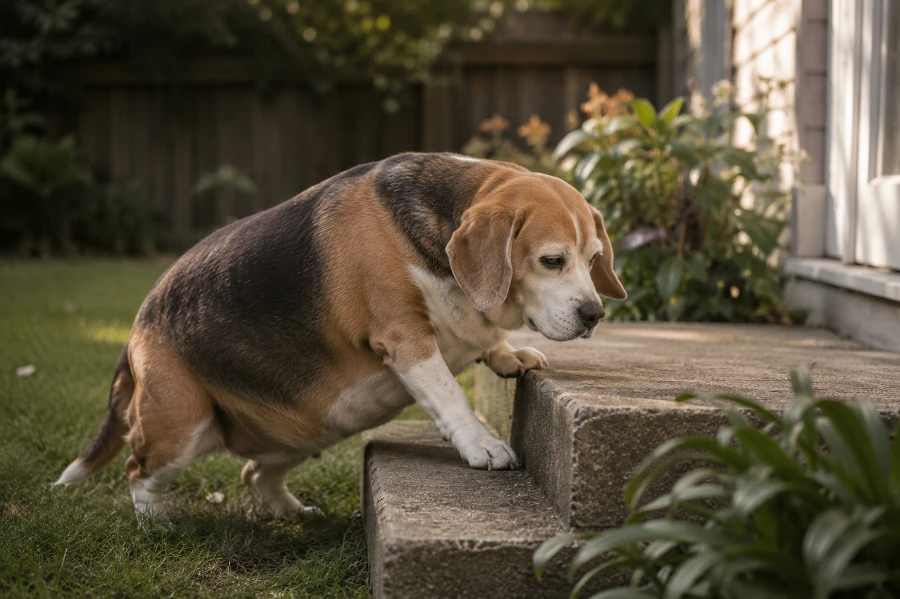
Weight gain is rarely just about “too much food.”
That’s the surface.
Underneath, there is often something else influencing how your dog’s body behaves.
Sometimes it’s reduced movement.
Sometimes it’s metabolic changes.
But in some cases, it can also be connected to early health issues that don’t look obvious yet.
When weight gain is not just weight
A dog who is gaining weight may also be:
- moving less because of discomfort
- resting more due to fatigue
- avoiding activity without making it obvious
And these changes can easily go unnoticed.
Because they don’t look dramatic.
They look… normal.
Subtle shifts in activity and comfort can often be linked to underlying conditions.
Why this matters early
If weight gain is connected to something deeper, addressing only food won’t be enough.
You might reduce portions…
…but the real cause stays there.
And over time, that’s what makes the situation harder to reverse.
This doesn’t mean you should worry about everything.
It just means:
weight is not only a number.
It’s a signal.
When Slowing Down Becomes a Cycle
One of the biggest risks with weight gain in senior dogs is not the weight itself.
It’s what comes with it.
A slow, almost invisible cycle.
How the cycle starts
It often begins with something small:
- slightly less movement
- a bit more rest
- a little extra weight
Nothing alarming.
But then:
weight increases → movement decreases
movement decreases → weight increases
And the cycle continues.
Reduced movement is often tied to discomfort that’s easy to miss at first.
Why breaking the cycle matters
Once this pattern settles in, everything becomes harder:
- your dog moves less
- muscles weaken faster
- energy drops
And even small activities start to feel like effort.
That’s why early intervention is not about “fixing weight.”
It’s about preserving movement.
Because movement is what keeps everything else working.
What You Can Do (Without Making It Worse)
This is where things get delicate.
Because helping a senior dog lose weight is not about “less food and more exercise.”
It has to be gentle. Balanced. Respectful of their age.
1. Adjust Food Gradually (Not Drastically)
Instead of cutting portions suddenly:
- reduce food slightly (10–15%)
- observe for 1–2 weeks
- adjust again if needed
Small changes are safer and more sustainable.
2. Choose the Right Type of Food
Senior dogs often benefit from:
- lower calorie density
- higher quality protein (to support muscle)
- easier digestion
It’s not just “less food.” It’s better food.
3. Rethink Treats
This is where many people lose control without realizing it.
A few small extras per day can equal:
- a full extra meal
- unnecessary calories
Try:
- reducing frequency
- using smaller portions
- replacing with healthier options
4. Keep Them Moving (Gently)
Movement is still essential.
But it must match your dog’s condition.
Instead of long or intense walks:
- shorter, more frequent walks
- slow and steady pace
- avoid hard surfaces if joints are sensitive
Consistency matters more than intensity.
5. Talk to Your Vet If Something Feels Off
If weight gain is:
- rapid
- unexplained
- accompanied by other changes
Don’t guess.
A simple check can rule out deeper issues.
Common Mistakes to Avoid
Good intentions can backfire if the approach is wrong.
❌ Cutting Food Too Much
This can lead to:
- nutritional deficiencies
- muscle loss
- increased weakness
Weight loss should never come at the expense of health.
❌ Ignoring Treats and Extras
“I barely feed him more…”
But:
- table scraps
- snacks
- little rewards
They add up quickly.
❌ Forcing Exercise
Pushing a senior dog too hard can:
- cause pain
- worsen joint problems
- create resistance to movement
Listen to their limits.
❌ Thinking “It’s Not a Big Deal”
This is the most dangerous one.
Because weight gain feels harmless.
Until it starts affecting everything else.
The Emotional Side (What We Don’t Talk About)
There’s something subtle that happens here.
Giving food feels like giving love.
An extra treat. A bigger portion. A little reward.
It feels right.
Especially when your dog is older.
Especially when you know time is more precious now.
So reducing food can feel… wrong.
Like you’re taking something away.
But here’s the shift:
You’re not taking something away.
You’re giving something back.
- easier movement
- less pain
- more energy
- more good days
And that matters more than any extra snack.
Final Thoughts
Weight gain in senior dogs is easy to ignore because it doesn’t look urgent.
It doesn’t scare you.
It doesn’t force you to act.
It just slowly becomes part of how your dog looks.
But your dog feels it.
In his joints.
In his breathing.
In the effort it takes to stand up, to walk, to follow you.
And the beautiful thing is:
This is one of the few problems you can actually improve.
Not overnight.
Not perfectly.
But gradually, gently, with care.
So the next time you look at him and think,
“He’s just a bit heavier…”
Pause for a second.
And ask yourself:
“Is this helping him… or making things harder?”
That question alone can change everything.