
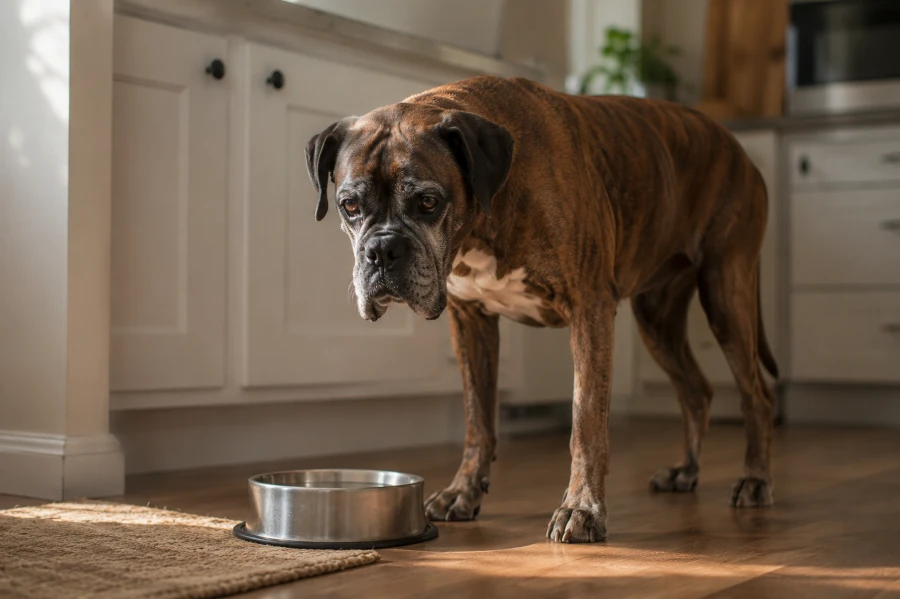
Kidney disease in senior dogs rarely begins with something dramatic.
Most of the time, it starts with a detail so small that you almost talk yourself out of noticing it.
Maybe your dog begins drinking more water than usual. Maybe the bowl is empty sooner than expected. Maybe he asks to go outside one more time during the day, then another. Nothing feels urgent at first. Nothing looks like a crisis.
That is exactly why this problem is so easy to miss.
When a dog grows older, we expect changes. Slower walks. Longer naps. A little less enthusiasm at certain moments of the day. So when something subtle shifts, the mind naturally goes to the same place: it’s probably just age.
But sometimes it isn’t “just age.”
Sometimes the body is struggling quietly.
Kidney disease is one of those conditions that can stay hidden for a long time. A dog may adapt, compensate, and continue behaving almost normally while the kidneys are already working less efficiently than they should. By the time the signs become obvious, the problem has usually been there for a while.
That can feel frustrating. Even guilty. You look back and wonder whether you should have noticed sooner.
Most people feel that way. Most people are unfair to themselves.
The truth is that kidney disease often moves in silence before it ever speaks clearly.
In this guide we will cover:
- what kidney disease actually means in an older dog
- the early signs that are easy to dismiss
- how the condition may affect behavior, appetite, and daily life
- practical ways to support your dog without creating more stress
- common mistakes that can make a hard situation even harder
What Kidney Disease Really Means in an Older Dog
The kidneys do quiet work, but they do a lot of it.
They help filter waste from the blood. They support fluid balance. They help the body maintain stability from day to day. When they are not working well, the body slowly loses some of that balance. Waste can build up, hydration becomes harder to regulate, and normal daily functions start becoming less normal.
In a senior dog, kidney disease is often chronic, which means it tends to develop gradually rather than all at once.
That gradual decline is important to understand. This is usually not a condition that flips on overnight. It is more like a slow reduction in the body’s ability to cope. And because aging already changes so many internal processes, kidney trouble can blend into a broader picture of physical changes that happen as a dog gets older.
That overlap is one reason owners hesitate.
They are not careless. They are just trying to interpret small signs in a dog who is already changing.
And that is not always easy.
Early Signs That Are Easy to Explain Away
In the early stage, kidney disease does not necessarily look severe.
It often looks vague.
In many cases, the problem develops slowly before becoming more noticeable.
A dog may:
- drink more than before
- urinate more often
- ask to go outside more frequently
- seem a little more tired
- show less interest in meals
- lose some weight over time
Each of these signs can seem manageable in isolation. Together, though, they tell a different story.
One of the most overlooked clues is weight change. Not dramatic, shocking weight loss in a week, but that slow, uncomfortable realization that your dog feels lighter than he used to. That is why it helps to pay attention to weight dropping without an obvious explanation.
The problem is not only what you see.
It is what you stop reacting to.
A dog drinks more, and after a few weeks that becomes normal. A dog leaves food in the bowl, and after a while you stop being surprised. A dog seems a little dull in the morning, and you adjust your expectations without fully realizing it.
This is how quiet illnesses settle into daily life.
In the beginning, everything tends to stay subtle.
The body adjusts, and the changes remain easy to explain or ignore.
But over time, that balance becomes harder to maintain.
What starts as small, scattered signs can slowly turn into something more consistent, more visible, and harder to dismiss.
When Kidney Problems Begin to Affect More Than the Body
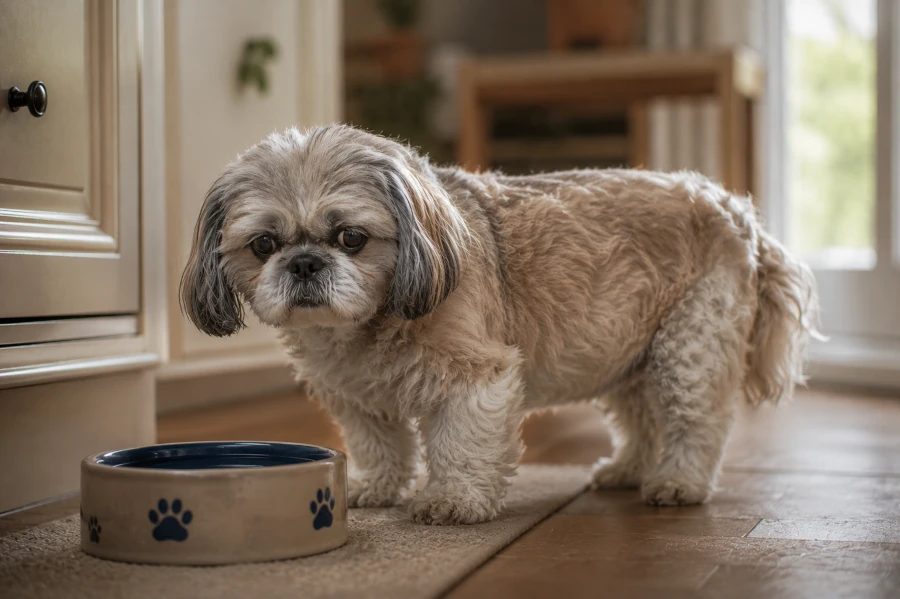
As the condition progresses, the signs tend to become harder to dismiss.
Your dog may start eating poorly. He may lose more noticeable weight. His breath may smell different. He may look tired in a deeper way, not simply sleepy but drained. Some dogs seem less engaged with their surroundings. Others become clingier, unsettled, or harder to read.
That emotional or behavioral layer matters.
When the body feels off for long enough, behavior often changes too. Some dogs seem confused at odd moments, almost as if they are struggling to fully process what is happening around them. In those cases, it can be helpful to recognize subtle episodes of confusion or unusual behavior in an older dog .
Other dogs become tense instead of confused.
They pace. They cannot settle. They look for you more often. They change sleeping positions constantly. Sometimes that is not a separate issue at all, but part of the same general discomfort. It helps to notice those signs of nervous tension that can appear in a senior dog who does not feel well.
This stage is emotionally hard because the dog in front of you is still your dog, but not always in the same way, with the same rhythm, or with the same ease.
You begin watching more closely.
You begin thinking more often.
You begin carrying a quiet level of concern through the day.
What You Can Actually Do
This is the part where people often become overwhelmed. They think support must mean doing everything perfectly.
It doesn’t.
It means doing the useful things consistently.
Make water easy to access
A dog with kidney problems may need more opportunities to drink.
Simple changes help:
- place more than one bowl around the house
- refresh the water often
- keep bowls in easy-to-reach places
- notice whether your dog prefers a quiet area to drink
Do not turn hydration into a battle.
Make it easier, not heavier.
Be gentler and smarter with food
Appetite changes are common, and they create panic fast. Once a dog starts eating less, owners often react by pushing, switching foods repeatedly, or trying too many things in one day.
That usually adds stress.
A calmer approach works better. Small meals may help. More moisture may help. Less pressure almost always helps. And when refusal becomes part of the picture, it is useful to understand how to respond when an older dog turns away from food.
The goal is not to “win” one meal.
The goal is to support the dog without making food feel like conflict.
Keep the routine steady
When a dog is not feeling well, predictability becomes reassuring.
Try to keep:
- mealtimes consistent
- rest areas comfortable
- daily rhythms calm
- stress and chaos as low as possible
You are not trying to create a perfect schedule. You are trying to remove unnecessary friction from the day.
Watch patterns, not single moments
One bad meal does not explain everything. One tired afternoon does not explain everything either.
Patterns matter more:
- Is your dog drinking more over several days?
- Is appetite lower for a full week?
- Is restlessness becoming frequent?
- Is the energy level changing little by little?
Watching patterns helps you stay grounded. It keeps you from minimizing real changes, but it also keeps you from panicking over every small fluctuation.
Do not neglect basic preventive care
When a dog develops a chronic issue, many owners mentally shift into crisis mode and forget the basics. But broader health maintenance still matters. Even now, there is value in staying attentive to the preventive side of senior care that still supports overall stability.
Not because prevention solves kidney disease, but because an older dog does better when the rest of his care is not falling apart around the problem.
Mistakes That Make This Harder
A few mistakes appear again and again.
The first is waiting too long because the signs seem mild.
The second is changing too many things at once.
The third is treating every skipped meal like an emergency confrontation.
The fourth is assuming that because a dog is old, every new change must be normal.
Age changes a dog.
But age can also hide real problems inside those changes.
That is why gentle attention matters so much.
Not obsession.
Not fear.
Attention.
Living With It Without Losing Yourself
Kidney disease changes the atmosphere of care.
You become more observant. More deliberate. More aware of water, food, energy, and mood. At times this can be exhausting, because the mind starts scanning for meaning in every little detail.
Try to remember that support is not the same as control.
You cannot control every symptom or every day.
You can make the day easier.
You can make your dog feel safer.
You can notice when something is changing.
And often, that quiet consistency is worth more than dramatic action.
A Final Thought
If you are reading this, you have probably already seen something that does not feel quite right.
Maybe it is the water bowl.
Maybe it is the appetite.
Maybe it is that feeling that your dog is still himself, but carrying something heavier inside.
Trust that feeling.
You do not need to become perfect overnight.
You do not need to solve everything in a single afternoon.
Start by noticing.
Then simplify.
Then support.
Because when a dog is moving through something quiet and difficult, what helps most is not panic, and it is not perfection.
It is steady care.
It is patience.
It is love that pays attention.