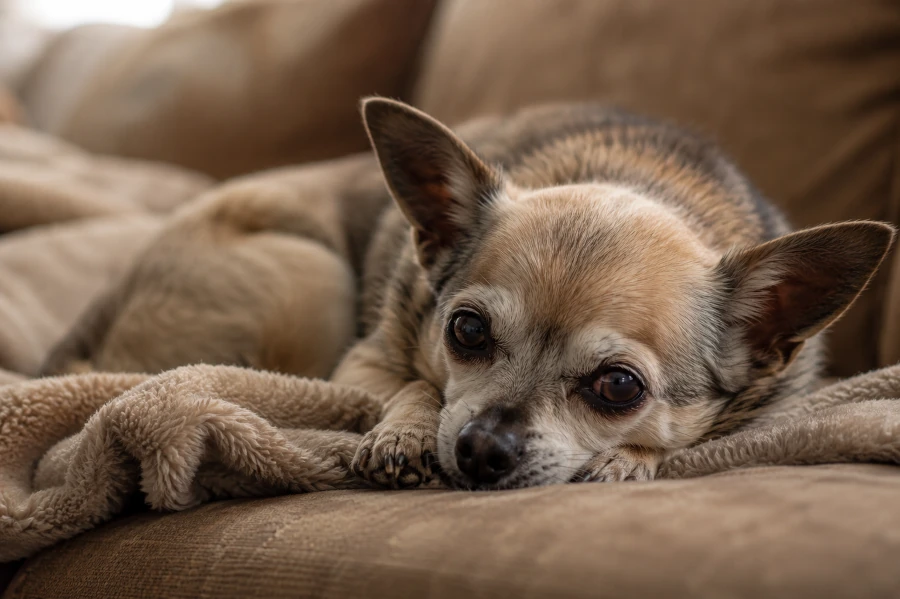
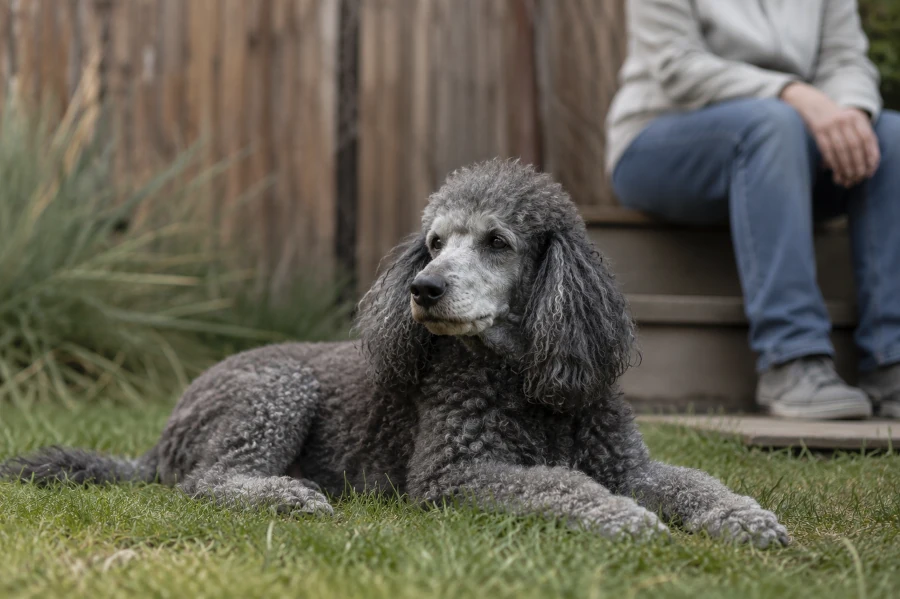
Cancer in senior dogs is one of those words that changes the air in the room the moment you hear it. Even before a diagnosis, the fear can start quietly. You find a lump while brushing your dog. You notice he is sleeping more deeply than usual. He still comes to you, still wags his tail, still tries to follow you from room to room, but something feels slightly different. Not dramatic. Just different enough to stay in your mind.
That is often how it begins.
If you are reading this, maybe you are in that exact place. You are not looking for abstract information. You are trying to understand what you may be seeing in your own dog, and whether you should worry now, later, or immediately. That uncertainty is exhausting. It sits in the background of the day. You keep watching him eat, stand up, breathe, rest. You keep asking yourself the same question: is this just aging, or is it something more?
In this guide we will cover:
- why cancer becomes more common in senior dogs
- the signs owners often notice first
- the most common forms cancer can take in older dogs
- what to do if you are worried
- common mistakes that make an already hard situation harder
- how to think about care, comfort, and quality of life
Why Cancer Becomes More Common in Older Dogs
A dog’s body changes with age in ways that are not always visible from the outside. When a dog is young, his body is usually better at repairing damage, controlling inflammation, and replacing old cells with new ones in an orderly way. As he gets older, those systems become less efficient.
That matters because cancer is, at its core, abnormal cell growth.
Cells are constantly dividing and renewing. Over time, mistakes can happen in that process. In many cases, the body catches those mistakes and removes the abnormal cells before they cause trouble. But in a senior dog, that control is not always as strong as it once was. The result is that unusual growths, masses, or internal changes become more likely.
This does not mean every old dog will develop cancer. It also does not mean every lump is dangerous. But age does raise the risk, which is why even small physical changes deserve more attention in a senior dog than they might in a very young one.
That is also why early observation matters so much. You are not expected to diagnose anything yourself. But you are the one who knows your dog’s normal face, normal walk, normal appetite, normal habits. A veterinarian may see him for twenty minutes. You see the tiny changes that happen before anyone else would notice them.
Many of these shifts are part of a broader process, and understanding what really changes inside your dog as he gets older can help you separate normal aging from something more concerning.
The Signs That Often Appear First
One of the hardest things about cancer in dogs is that the first signs are not always dramatic. Sometimes they are so subtle that you question whether they are real at all.
A lump or bump under the skin is one of the most common things owners notice first. It may feel soft, firm, movable, or fixed in place. It may stay the same for weeks, or seem to grow quickly. Some lumps turn out to be harmless fatty masses. Others are not harmless at all. The problem is that you cannot tell with certainty just by touching them.
But external lumps are only one possibility.
In many dogs, the first signs are more general:
- lower energy than usual
- less interest in walks
- reduced appetite
- unexplained weight loss
- slower recovery after activity
That last point often overlaps with cases where owners notice sudden changes in body weight without a clear reason, which should never be ignored in a senior dog.
The Most Common Types of Cancer in Senior Dogs
Cancer is not one single disease with one single pattern. It is a broad category, and different types behave in different ways.
Some cancers are found on or near the skin. These are often noticed earlier because you can feel them. A mass on the leg, chest, side, or neck may be the first clue.
Other cancers involve the lymphatic system. In those cases, owners may notice enlarged lymph nodes, especially under the jaw or behind the knees.
Bone cancer is another form that often appears in older dogs. It may first look like a limp that does not improve. Because older dogs commonly develop joint issues, this kind of pain can be misunderstood at first, especially if you are already dealing with mobility problems that seem similar to arthritis.
There are also internal cancers affecting organs such as the liver or spleen. These can be the hardest to spot early because there may be no visible lump at all.
Why Owners Sometimes Miss It
Missing early signs does not mean you were careless.
It usually means your dog is doing what dogs do best: trying to stay close to normal for as long as possible.
Dogs do not explain pain. They adapt to it. They rest more. They avoid certain movements. They become quieter. They change their routines just enough that it can look like ordinary aging.
Sometimes, what you are seeing is not just aging but part of a wider group of issues described in the most frequent health problems older dogs develop over time, which can overlap and confuse the picture.
What to Do If You Are Worried
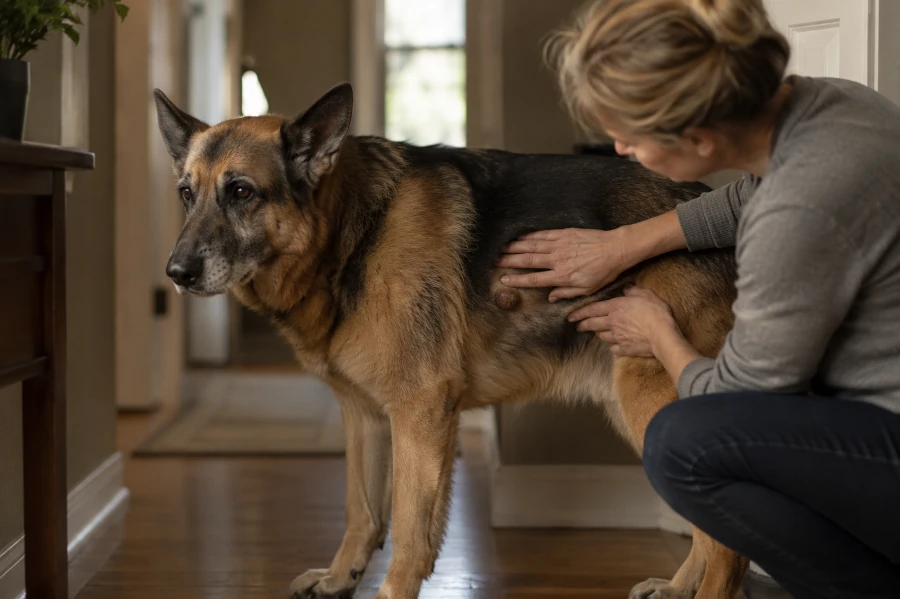
If you suspect something might be wrong, simple steps are usually the best ones.
First, observe clearly. Try not to rely only on memory. Write down what you notice:
- when the sign started
- whether it is getting worse
- appetite and drinking
- energy level
- sleep pattern
Second, book a veterinary visit instead of trying to guess from the outside.
Third, keep your dog’s routine as stable as possible.
And while you’re focusing on health, don’t overlook the basics. Supporting your dog with a diet that actually fits his age and condition can make a real difference in how he copes physically.
Fourth, watch your dog’s comfort. A dog does not need to cry to be uncomfortable.
Practical Ways to Support a Dog During This Stage
Even before you have full answers, there are useful things you can do without overwhelming yourself.
- Keep meals simple and appealing
- Make water easy to reach
- Reduce slippery surfaces
- Avoid unnecessary strain
- Give him a quiet place to rest
Sometimes small adjustments in daily life matter more than big interventions. Even something as simple as maintaining a stable daily rhythm that doesn’t overwhelm your dog can help him feel safer and more stable.
And sometimes, what matters most is not doing more, but understanding what your dog is going through and when comfort becomes the priority.
Common Mistakes to Avoid
Many owners don’t realize how early these signs can start to appear.
There are a few errors that happen often, especially when fear is involved.
- Waiting too long because the dog still seems “mostly okay”
- Assuming a lump is harmless because it does not hurt
- Jumping straight to the worst conclusion
- Focusing only on cure and ignoring comfort
- Comparing your dog to others
Each situation is different, and your dog’s path will be his own.
The Emotional Weight of the Word “Cancer”
There is a particular kind of heartbreak in watching an old dog sleep and wondering what is happening inside his body.
You look at him and he is still himself. Maybe slower, maybe grayer, maybe thinner around the face. But still himself.
Love does not become smaller with age. It becomes heavier, quieter, more real.
So when the possibility of cancer appears, it touches everything. Routine, memory, fear, guilt, hope.
Try not to carry all of it at once.
Your role is not to control everything. It is to notice, to respond and to stay.
A Final Thought
Senior dogs change how we experience time.
You start to understand that care is not only about fixing. Sometimes it is about adjusting. Sometimes it is about presence.
If cancer becomes part of your dog’s story, it does not erase what you built together. It does not erase the years, the habits, the quiet companionship.
It only asks for something different now.
Steadiness.
And if you can give that—calm, attentive, real—then your dog is not facing anything alone.