
Hearing loss in senior dogs rarely announces itself in a clear way.
There is no single moment where everything changes.
Instead, it starts with something small.
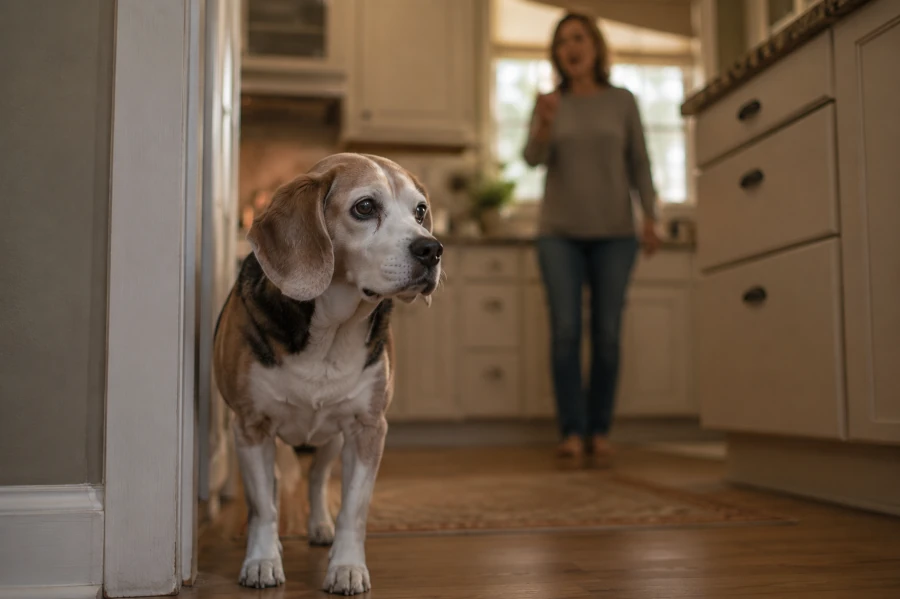
Your dog doesn’t come when you call him.
He sleeps more deeply than usual.
He doesn’t react to a familiar sound — the leash, the food bowl, your voice from another room.
At first, it is easy to think he is ignoring you.
Maybe he is being stubborn.
Maybe he is just tired.
Maybe he “doesn’t feel like it.”
But then you notice something else.
He startles when you touch him.
He doesn’t wake up when you enter the room.
He looks at you, but only after seeing movement — not after hearing your voice.
And slowly, a different possibility becomes hard to ignore.
What if he simply can’t hear you anymore?
In this guide we will cover:
- early signs of hearing loss in senior dogs
- why it happens and what causes it
- how hearing loss affects behavior
- practical ways to communicate with your dog
- how to keep him safe and confident
- common mistakes to avoid
The Early Signs Most Owners Miss
Hearing loss does not always look like “not hearing.”
It often looks like behavior.
A dog who used to respond instantly may now hesitate. He may come only when he sees you. He may ignore commands that were once automatic.
Some early signs include:
- not responding when called from another room
- sleeping through noises that used to wake him
- increased startle response when touched
- barking more or less than usual
- difficulty locating the source of a sound
- watching you more closely than before
- following visual cues instead of voice
One of the biggest clues is inconsistency, often connected to broader behavioral changes.
Your dog may respond sometimes, especially when he is looking at you, and ignore you at other times. This can make it feel like he is choosing when to listen.
But he is not choosing.
He is compensating.
And if you do not recognize that, frustration can build — on both sides.
These subtle changes are often part of broader aging patterns described in broader behavioral changes.
Why Senior Dogs Lose Their Hearing
Hearing loss in older dogs is often part of the natural aging process, and in many cases it belongs to a wider group of conditions.
Over time, the structures inside the ear can degrade. The tiny hair cells that detect sound vibrations become less effective, and signals to the brain weaken.
This type of hearing loss is usually gradual.
But there are other possible causes as well:
- chronic ear infections
- ear canal inflammation
- buildup of wax or debris
- injury to the ear
- certain medications
- neurological conditions
Sometimes, hearing loss can be partial. Your dog may still hear low frequencies or very loud sounds, but not softer or higher-pitched ones.
This is why you might clap loudly and get a reaction, but calling his name softly does nothing.
Understanding that hearing loss exists on a spectrum helps you adjust your expectations.
Many of these underlying issues are also included in a wider group of conditions.
Your dog is not “completely deaf” or “perfectly fine.”
He is somewhere in between.
How Hearing Loss Changes Behavior
One of the hardest parts of hearing loss is how easily it gets misinterpreted.
A dog who cannot hear well may seem:
- stubborn
- disobedient
- distracted
- distant
But the reality is different, and sometimes overlaps with changes linked to cognitive decline.
Your dog may be working harder than ever to understand you.
He may rely more on sight, smell, and routine. He may watch your body language closely. He may follow you from room to room just to stay connected.
You might also notice emotional changes.
Some dogs become more attached. Others seem more independent. Some become anxious in unfamiliar environments, where they cannot rely on sound to understand what is happening.
Startling becomes more common.
If your dog does not hear you approach and suddenly feels your touch, he may jump, bark, or even snap out of reflex. This is not aggression. It is surprise.
Instead of correcting him, you begin to warn him — gently, visually, predictably.
When Silence Changes Your Routine
Hearing loss does not just affect communication. It changes daily life in subtle ways.
Think about how often your dog relied on sound without you realizing it.
The sound of your footsteps.
The click of a door.
The rattle of a leash.
Your voice calling from another room.
When those signals disappear, your dog has less information about the world.
This can lead to:
- deeper sleep (because fewer sounds wake him)
- increased reliance on visual contact
- staying closer to you
- confusion when you leave or enter silently
- difficulty locating you in the house
At first, this can feel like distance.
But in many cases, it leads to the opposite.
Your dog may seek more visual connection, a pattern often seen in age-related behavior changes. He may watch you more closely. He may stay within sight more often.
Not because he is needy.
Because he is adapting.
How to Communicate Without Sound
This is where everything changes — and where many owners discover something unexpected.
You can still communicate clearly with your dog.
You just need a different language.
Use visual cues
This works best when built around creating a stable daily structure.
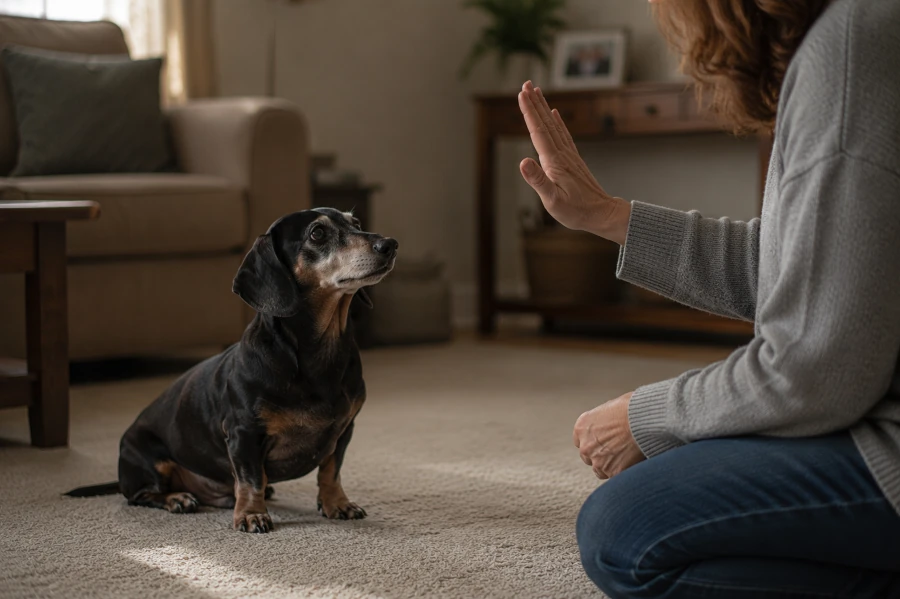
Hand signals can replace verbal commands.
For example:
- a raised hand for “stop”
- a sweeping motion for “come”
- pointing for direction
Consistency matters more than complexity. Use the same gestures every time.
Get your dog’s attention first
Before giving any signal, make sure your dog is looking at you.
You can:
- gently tap the floor
- wave your hand in his peripheral vision
- use a light touch if needed
Use touch carefully
Touch becomes a form of communication, but it must be predictable.
Approach from the front or side. Let your dog see you before contact whenever possible.
Reinforce with routine
Routine becomes your strongest tool.
Feeding times, walks, rest periods — keeping them consistent reduces confusion and builds confidence.
Over time, your dog learns what to expect without needing to hear it.
Keeping Your Dog Safe
Hearing loss introduces risks, especially outdoors.
A dog who cannot hear:
- may not hear approaching cars
- may not respond to verbal recall
- may not notice other animals
Because of this, safety becomes more important.
Simple precautions can make a big difference, especially when focused on making your home safer and easier to navigate:
- keep your dog on a leash in open or unsafe areas
- use a secure, fenced space for off-leash time
- avoid relying on voice commands at a distance
- use a collar tag indicating hearing loss if needed
- be cautious in busy environments
Inside the home, safety is usually easier to manage.
The main focus is avoiding sudden scares and maintaining a predictable layout.
Helping Your Dog Stay Confident
Confidence does not come from hearing.
It comes from understanding the environment.
You can support your dog by recognizing early signs of discomfort or stress and then:
- keeping routines consistent
- maintaining a calm, predictable presence
- allowing him to explore safely
- avoiding sudden changes in layout or habits
- rewarding calm, confident behavior
It is important not to treat your dog as fragile.
He can still learn. He can still adapt. He can still enjoy life.
The goal is not to protect him from everything.
It is to give him the tools to navigate his world.
When to Talk to Your Vet
Hearing loss that develops gradually with age is common.
But there are situations where a vet visit is important.
Contact your vet if:
- hearing loss appears suddenly
- your dog shows signs of pain (scratching ears, whining, head shaking)
- there is discharge or odor from the ear
- behavior changes rapidly
- your dog seems disoriented or unbalanced
Some causes of hearing loss are treatable, especially if related to infections or blockages.
Even when hearing cannot be restored, a diagnosis helps you understand what is happening and how to respond.
Common Mistakes Owners Make
One common mistake is assuming your dog is being disobedient.
Correcting a dog who cannot hear you only creates confusion and stress.
Another mistake is relying too much on voice out of habit.
If your dog cannot hear, repeating commands louder will not solve the problem.
Some owners also unintentionally scare their dog by touching him without warning.
This can damage trust over time.
Overprotecting is another issue.
If you limit your dog too much, you may reduce his confidence. He needs guidance, not restriction.
Finally, some owners emotionally withdraw, feeling that communication is “lost.”
But it is not lost.
It is simply different.
The Part You Don’t Expect
At some point, you may realize something surprising.
Your dog still understands you.
Not through words, but through presence.
Through routine.
Through movement.
Through the way you enter a room, the way you look at him, the way you reach out your hand.
You may find that your communication becomes quieter, slower, more intentional.
Less automatic.
More aware.
And in that space, something shifts.
Your dog is not the same as before.
But the connection is still there.
Maybe even clearer in some ways.
Because it no longer depends on sound.
It depends on attention.
And as long as you keep showing up — in ways he can understand — your dog will keep meeting you there.