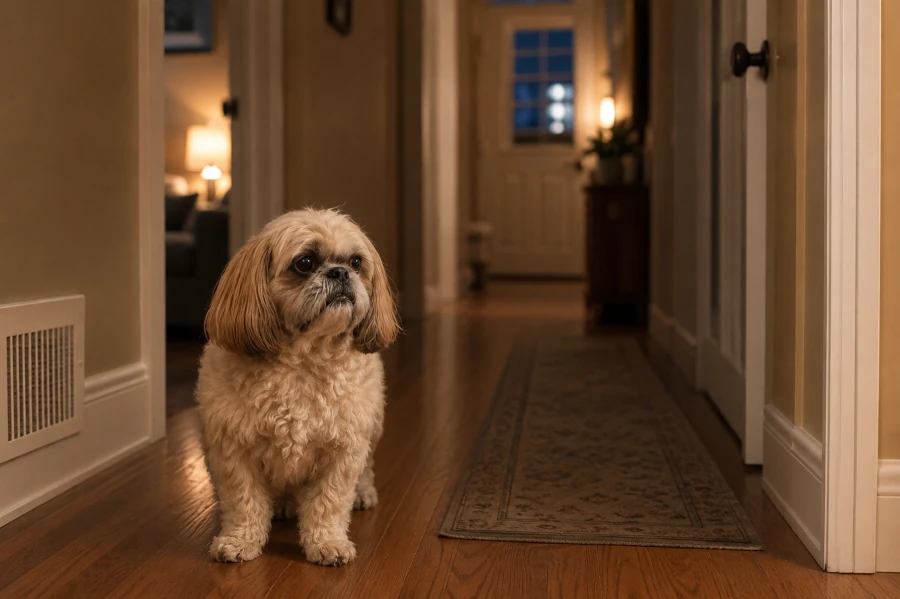
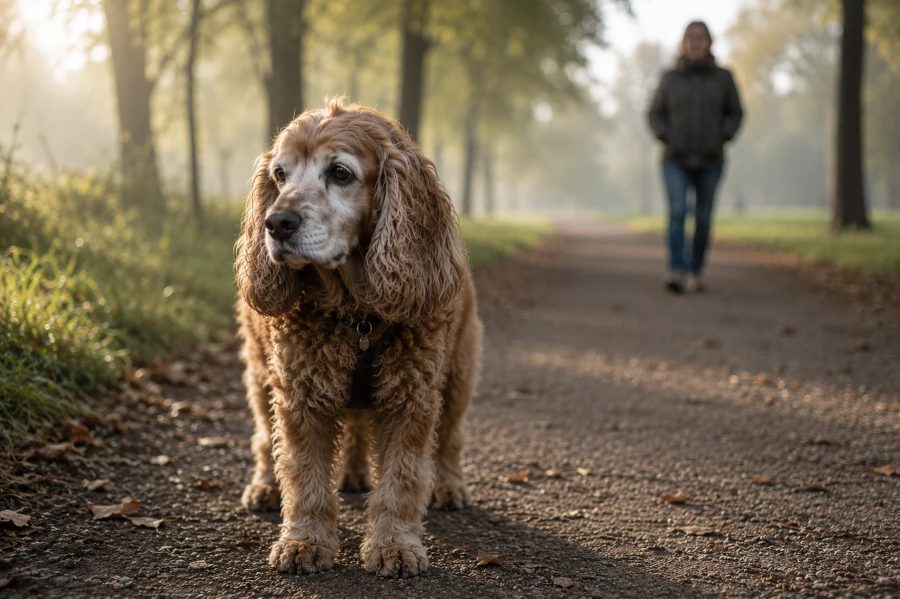
Canine dementia in dogs doesn’t start with something obvious.
It starts with a pause.
A small, almost invisible pause.
Your dog walks into the room… and then just stands there.
Not looking at anything in particular. Not doing anything wrong. Just… still.
You call his name.
Half a second longer than usual… and then he reacts.
That half second is where it begins.
I remember thinking it was nothing. Just a strange moment.
But then it happened again. And again. Not every day. Not even every week.
Just enough to leave a question behind.
And once that question is there, you start noticing more.
That’s the thing about canine dementia:
you don’t see it all at once.
You slowly realize it’s been there for a while.
In this guide we will cover:
- What canine dementia (CCD) really is in simple terms
- The early signs that are easy to miss
- How symptoms evolve over time
- What daily life looks like with a dog with CCD
- What you can realistically do to help
- The most common mistakes owners make
What Canine Dementia Really Is (Without Complicating It)
Canine dementia, or CCD, is a gradual decline in brain function.
But that definition doesn’t really help you understand it.
A better way to think about it is this:
Your dog is still there…
but the way his brain processes the world is changing.
He may:
- forget routines
- react more slowly
- struggle to understand familiar situations
It’s not a switch that turns off.
It’s more like a dimmer that slowly lowers the clarity of everything.
And because it’s gradual, you adapt to it without realizing.
According to clinical veterinary references, symptoms can appear later than expected.
Until one day, you look back and think:
“Something has really changed.”
Another important thing to understand is that CCD doesn’t affect everything equally.
Some abilities remain stable longer.
Others change more quickly.
This is why your dog may still respond normally in some situations…
and seem completely confused in others.
That inconsistency is part of the condition.
And it’s often what makes it so hard to interpret.
Why CCD Is So Hard to Recognize Early
One of the biggest challenges with canine dementia is not the condition itself.
It’s recognizing it early.
Because the first signs don’t look like a problem.
They look like personality.
Or aging.
Or just a “strange day.”
Your dog pauses.
Your dog hesitates.
Your dog trembles.
Your dog reacts slightly slower.
Nothing alarming.
Nothing urgent.
But repetition changes meaning.
A single moment means nothing.
A pattern means something.
And CCD often starts exactly like that:
small, repeated moments that don’t feel important — until they add up.
The Early Signs You Almost Always Miss
The early stage of CCD is not dramatic.
That’s why most people miss it.
Subtle Disorientation
Your dog might:
- stop in the middle of a familiar path
- hesitate before going through a doorway
- look around as if something feels “off”
Not lost.
Just… uncertain.
Delayed Responses
You call him.
He hears you.
But the reaction takes longer.
Not seconds. Just a fraction.
But you notice it because you know him.
Slight Changes in Interaction
He still greets you.
But maybe:
- with less intensity
- with a small delay
- without that immediate spark
It’s not absence.
It’s reduced clarity.
Small Routine Breaks
Things he always did automatically… now require effort.
- going to the wrong side of the door
- waiting in the wrong place for food
- forgetting what he was about to do
These moments are easy to dismiss.
But they’re the foundation of everything that follows.
How CCD Progresses (And Why It Feels So Hard)
CCD is not just a list of symptoms.
It’s a transformation of daily life.
Stage 1: “Something Feels Off”
- occasional confusion
- subtle behavioral shifts
- minor sleep changes
This is the phase of doubt.
You don’t know if it’s real.
Stage 2: “This Is Not Just Aging”
- frequent disorientation
- noticeable sleep disruption
- changes in interaction
- occasional anxiety or restlessness
Now it becomes harder.
Because you can’t ignore it anymore.
Stage 3: “Everything Is Different”
- severe confusion
- getting stuck in corners or behind objects
- not recognizing familiar routines
- major sleep disturbances
- possible lack of recognition
This is where the emotional weight hits.
Not because your dog is gone, but because you’re starting to feel a distance that wasn’t there before.
But because he’s not fully the same.
Another important aspect is that progression is rarely linear.
Some days feel better.
Others feel worse.
And this variability can make you question what you’re seeing.
But inconsistency doesn’t mean the problem isn’t real.
It often means it’s evolving.
What Daily Life Starts to Look Like
This is the part no one really explains.
CCD is not just about symptoms.
It’s about how everyday moments change.
Nights Become Unpredictable
Your dog may:
- wake up and wander
- pace without reason
- seem restless or anxious
And you wake up too.
Not because you have to.
Because you’re listening.
Simple Things Take Longer
- going outside
- finding the water bowl
- settling down to sleep
Everything becomes slightly slower.
You Start Anticipating Problems
You adjust without thinking:
- guiding him instead of calling
- watching him more closely
- simplifying his environment
You become more present.
Not out of fear.
But out of care.
Small Environmental Changes That Help More Than You Think
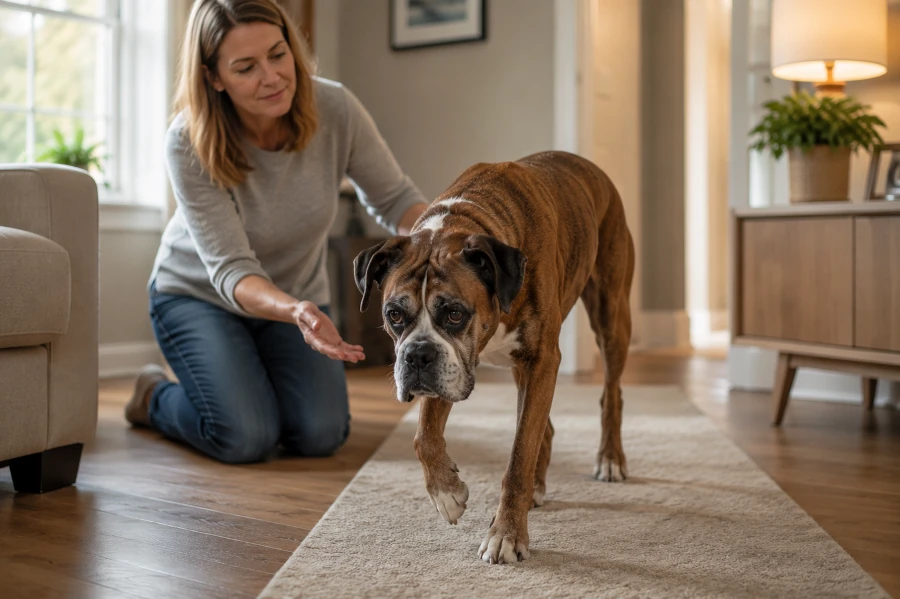
In many cases, you don’t need complex solutions.
You need clarity.
Your dog’s world should feel simple and predictable.
For example:
- keep furniture in the same position
- maintain clear, open pathways
- avoid unnecessary changes in layout
- keep food, water, and sleeping areas consistent
Even lighting matters.
Dim or uneven lighting can increase confusion.
A stable, well-lit environment makes navigation easier.
These adjustments may seem small.
But they reduce the amount of “thinking” your dog has to do.
And that’s exactly what helps.
What You Can Actually Do (That Makes a Real Difference)
You can’t reverse CCD.
But you can absolutely influence how your dog experiences it.
1. Build a Predictable World
Routine is everything now.
Same times. Same order. Same patterns.
- meals at consistent hours
- walks that follow familiar routes
- daily rhythm that doesn’t change
Predictability reduces confusion.
2. Simplify the Environment
Your home should feel easy to navigate.
- avoid moving furniture
- keep pathways clear
- reduce clutter
Think: less thinking required.
3. Use Gentle Guidance
Instead of calling from a distance:
- walk toward him
- guide him physically (gently)
- use calm voice cues
Make things easier to understand.
4. Support Sleep (Yours and His)
Night disruption is exhausting.
Help by:
- keeping a consistent evening routine
- allowing a comfortable, safe sleeping space
- reducing nighttime stimulation
Sometimes small adjustments change everything.
5. Keep Connection Simple
You don’t need complex stimulation.
What matters is:
- your presence
- your voice
- calm interaction
Even if recognition fades, emotional connection often remains.
When to Take It Seriously
Some signals should not be ignored.
Even if they seem mild.
Pay attention if you notice:
- frequent disorientation in familiar places
- persistent night restlessness
- repeated confusion around food or routine
- increased anxiety without clear cause
These are not isolated events.
They are patterns.
And acting earlier makes everything easier to manage.
Common Mistakes That Make Things Worse
❌ Treating It Like Disobedience
Your dog is not ignoring you.
He’s struggling to process.
❌ Changing Too Many Things at Once
New food, new routine, new environment…
Too much change increases confusion.
❌ Expecting the Same Dog
Holding onto the past creates frustration.
Adapting to the present creates calm.
❌ Ignoring Early Signs
The earlier you adjust, the easier everything becomes.
The Emotional Side (The Part You Feel But Don’t Say)
There’s a moment that stays with you.
It’s when your dog looks at you…
and there’s a slight delay before recognition.
Not absence.
Just distance.
And that distance feels heavy.
Because you’ve shared years together.
Routines. Habits. Silent understanding.
And now something is shifting.
But here’s what I realized, slowly:
Recognition is not the only form of connection.
Your dog still responds to:
- your voice
- your presence
- your calm
Even when memory fades, familiarity can remain in a different form.
And sometimes, that’s enough.
Final Thoughts
Canine dementia is not a sudden loss.
It’s a gradual change that asks you to adapt.
To slow down.
To simplify.
To meet your dog where he is now—not where he used to be.
And in a strange way, it brings something back.
Not energy. Not youth.
But presence.
Because now, every small moment matters more.
A calm walk.
A quiet moment together.
A simple interaction that still feels right.
You may feel like you’re losing something.
But you’re also being given a chance:
To care differently.
To connect differently.
To stay… even as things change.
And that matters more than perfection.