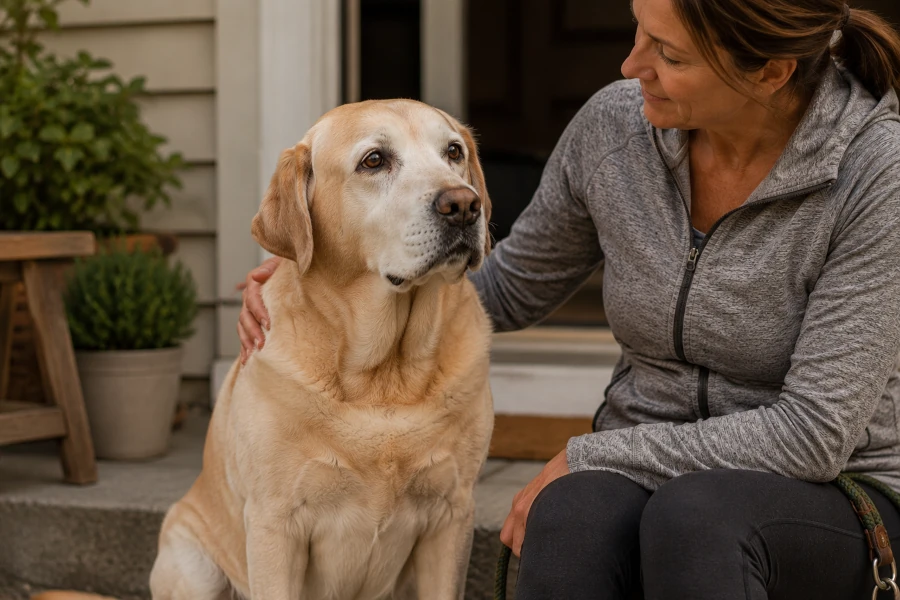
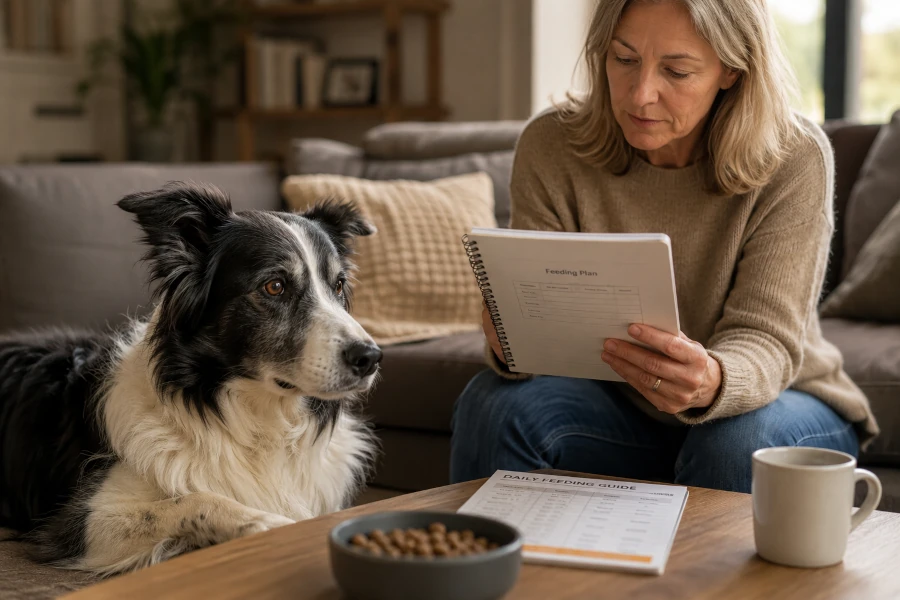
I remember thinking it would be simple.
Same dog. Same food. Just… a bit older.
So I kept doing what I had always done.
Same bowl. Same portions. Same routine.
And for a while, everything seemed fine.
Until it wasn’t.
At first, it was just a small change. A bit of weight gain I couldn’t fully explain. Then, weeks later, the opposite: he started leaving food behind.
That’s when the doubt started creeping in.
Was I feeding too much?
Or not enough?
And more importantly… how do you even know?
If you’re here, you’ve probably asked yourself the same question.
Because feeding a senior dog is no longer automatic. It’s no longer “fill the bowl and forget it.”
Calories suddenly matter.
But not in the way you think.
In this guide we will cover:
- how calorie needs actually change with age
- why standard feeding guidelines often fail
- what really determines your dog’s energy needs
- how to adjust food without overcorrecting
- how to read your dog instead of relying on numbers
The Illusion of “Standard Portions”
One of the biggest mistakes I made was trusting the label.
You know the one.
“Dogs of this weight → X grams per day.”
It feels precise. Scientific. Reliable.
But here’s the problem:
Those numbers are averages.
And your dog is not an average.
Two dogs:
- same breed
- same weight
- same age
Can have completely different calorie needs.
Why?
Because calorie needs are not just about size.
They’re about how the body uses energy and how metabolism changes.
And that changes a lot with age.
What Really Changes in a Senior Dog
When people say “older dogs need fewer calories,” they’re not wrong.
But they’re simplifying something that is actually more complex.
Several things happen at the same time:
1. Reduced Activity (Obvious, but underestimated)
Most senior dogs move less.
Not because they don’t want to.
But because:
- joints are stiffer
- recovery is slower
- energy is lower
Even a small daily reduction in movement can significantly impact calorie needs over time.
2. Slower Metabolism (Less obvious, more important)
The body becomes less efficient at burning energy.
Calories that used to be “used immediately” are now stored more easily.
This is why:
- same food
- same routine
can suddenly lead to weight gain.
3. Loss of Muscle Mass (Critical factor)
This is the one most people miss.
Muscle burns energy.
Fat doesn’t.
As dogs age, they gradually lose muscle—even if their weight looks stable.
And when muscle decreases:
- metabolism slows further
- calorie needs drop
- fat accumulation becomes easier
So even if the number on the scale doesn’t change much, the body composition does.
Why “Just Reduce Food” Is the Wrong Strategy
This is where things usually go wrong.
You notice weight gain.
So you cut food.
It seems logical.
But here’s the problem:
When you reduce food blindly, you reduce everything.
Not just calories.
You also reduce:
- protein
- essential nutrients
- micronutrients that support aging
Over time, this can lead to:
- muscle loss
- weakness
- poorer recovery
- overall decline
So yes, your dog might lose weight.
But not in a healthy way.
This is why understanding nutrition needs for senior dogs is essential before making any changes.
And sometimes, the issue is not just quantity, but how the diet supports conditions like weight gain.
The Real Goal: Energy Balance, Not Restriction
Instead of thinking:
“I need to feed less”
You should think:
“I need to match what he needs now”
That’s a completely different mindset.
Because it focuses on:
- balance
- adaptation
- observation
Not restriction.
How Many Calories Does Your Dog Actually Need?
Here’s the truth:
There is no exact number that works for everyone.
But there is a process that works for every dog.
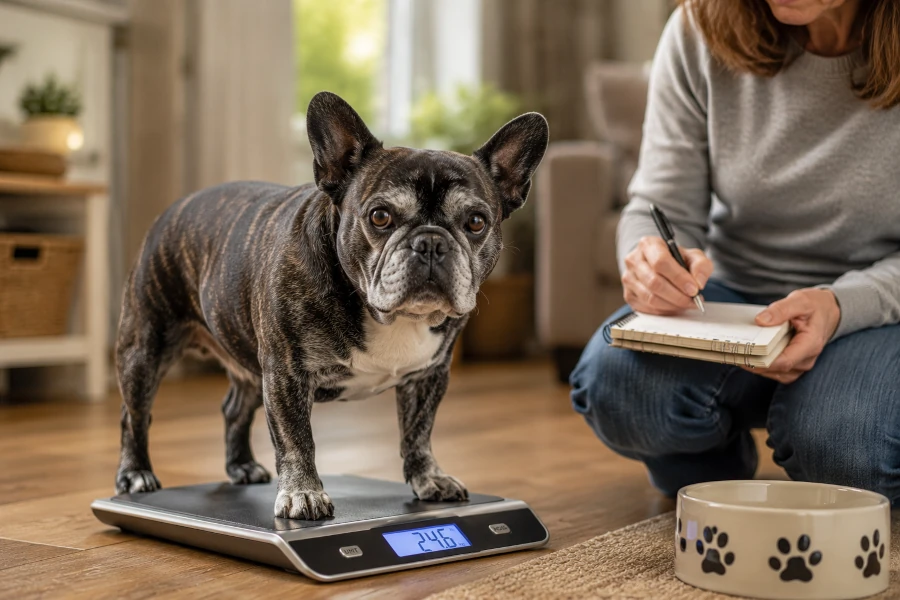
Step 1: Start from what you’re already doing
Don’t reset everything.
Look at:
- current portion
- current weight
- current energy level
This is your baseline.
Step 2: Observe trends, not single days
Your dog doesn’t change in one day.
Look at patterns over time:
- Is weight slowly increasing?
- Is appetite becoming inconsistent?
- Is energy stable or declining?
These trends tell you more than any calculator.
Step 3: Adjust gradually
This is where most people mess up.
They change too much, too fast.
Instead:
- adjust portions slightly (5–10%)
- wait at least 1–2 weeks
- observe again
This avoids overcorrection.
Weight Gain: The Silent Drift
Weight gain in senior dogs rarely happens suddenly.
It’s slow.
Almost invisible at first.
A bit more softness around the ribs.
A slightly less defined waist.
Nothing alarming.
Until one day, it is.
And the reason is simple:
Small daily calorie excess → accumulated over time.
The dangerous part is not the gain itself.
It’s how easy it is to miss it.
Weight Loss: The Opposite Problem
On the other side, there’s weight loss.
And this one feels more alarming.
Because it often seems to happen “without reason.”
But there are usually reasons:
- reduced appetite
- slower digestion
- lower nutrient absorption
- underlying conditions
Sometimes it’s normal.
Sometimes it’s not.
The key difference is consistency.
Occasional fluctuations are fine.
Progressive, ongoing loss is not something to ignore, especially when it resembles patterns seen in sudden weight loss.
Appetite Is No Longer Reliable
One of the biggest mistakes is trusting appetite as a guide.
With younger dogs, it works.
With senior dogs, not always.
Why?
Because appetite becomes less stable.
Some days:
- strong
- immediate
Other days:
- hesitant
- distracted
- reduced
This doesn’t necessarily reflect calorie needs.
It reflects internal changes, often similar to what happens with loss of appetite.
So you can’t rely on appetite alone.
The Role of Food Quality
Here’s something that changes everything:
Calories are not all equal.
100 calories from low-quality food ≠ 100 calories from high-quality food.
Especially in senior dogs.
Because now, the body needs:
- efficient digestion
- better nutrient absorption
- higher-quality protein
This means:
You can sometimes feed slightly less…
But still support your dog better.
Treats: The Hidden Calories
This is where many people unknowingly sabotage everything.
Treats.
They seem small.
Harmless.
But they add up.
A few extra calories per day → weeks → months → weight gain.
And because they’re not part of the “main meal,” they’re often ignored.
If something doesn’t add up…
Look at treats first.
A Practical Example
Let’s make this real.
Imagine your dog:
- slightly less active
- gaining weight slowly
Instead of cutting 30% of food:
You:
- reduce 10%
- monitor for 2 weeks
- adjust again if needed
At the same time:
- keep activity consistent
- don’t change everything else
This approach:
- prevents mistakes
- keeps the system stable
- respects the dog’s adaptation
Common Mistakes That Create Problems
Even with good intentions, these happen all the time:
Cutting food too aggressively
→ leads to weakness and muscle loss
Changing diet too often
→ creates digestive instability
Ignoring gradual changes
→ small issues become big ones
Comparing with other dogs
→ leads to wrong adjustments
Looking for a perfect number
→ instead of observing the dog
Why Finding the Right Balance Takes Time
There’s something uncomfortable about all this.
Because feeding your dog used to be simple.
And now it’s not.
Reducing food can feel wrong.
Like you’re taking something away.
Like you’re doing less.
But in reality, you’re doing more.
You’re adapting.
You’re paying attention.
You’re responding to what he needs now.
Not what he needed before.
And that shift… is not easy.
What “Right Feeding” Actually Looks Like
It doesn’t look perfect.
It looks stable.
A dog that:
- maintains weight
- eats with moderate consistency
- has steady energy
- doesn’t show extremes
No dramatic changes.
No constant adjustments.
Just balance.
Conclusion
How many calories a senior dog needs is not a fixed number.
It never really was.
But with age, that becomes more obvious.
Because everything becomes more sensitive.
More variable.
More dependent on small details.
You don’t need perfect calculations.
You don’t need rigid rules.
You need awareness.
Watch your dog.
Notice patterns.
Adjust slowly.
Because at this stage, feeding him is not about precision.
It’s about understanding.
And that’s what truly makes the difference.